Bluff Stabilization — Sheridan Park
Lake Michigan Bluffs in Milwaukee County
Bluffs are steep slopes made of sediments (rocks, clay, and sand) that are natural to Lake Michigan’s coastline and often shaped by erosion. The erosion process can disrupt parks, roads, homes, and wildlife.
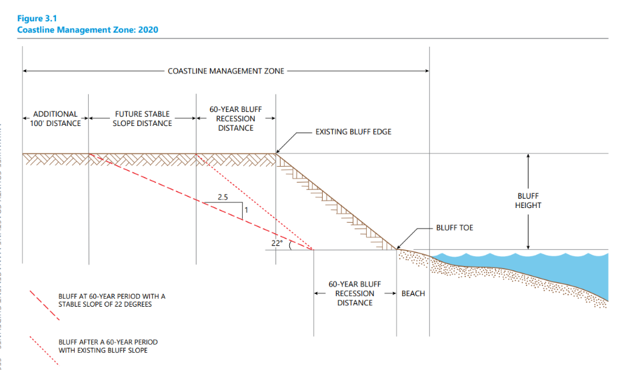
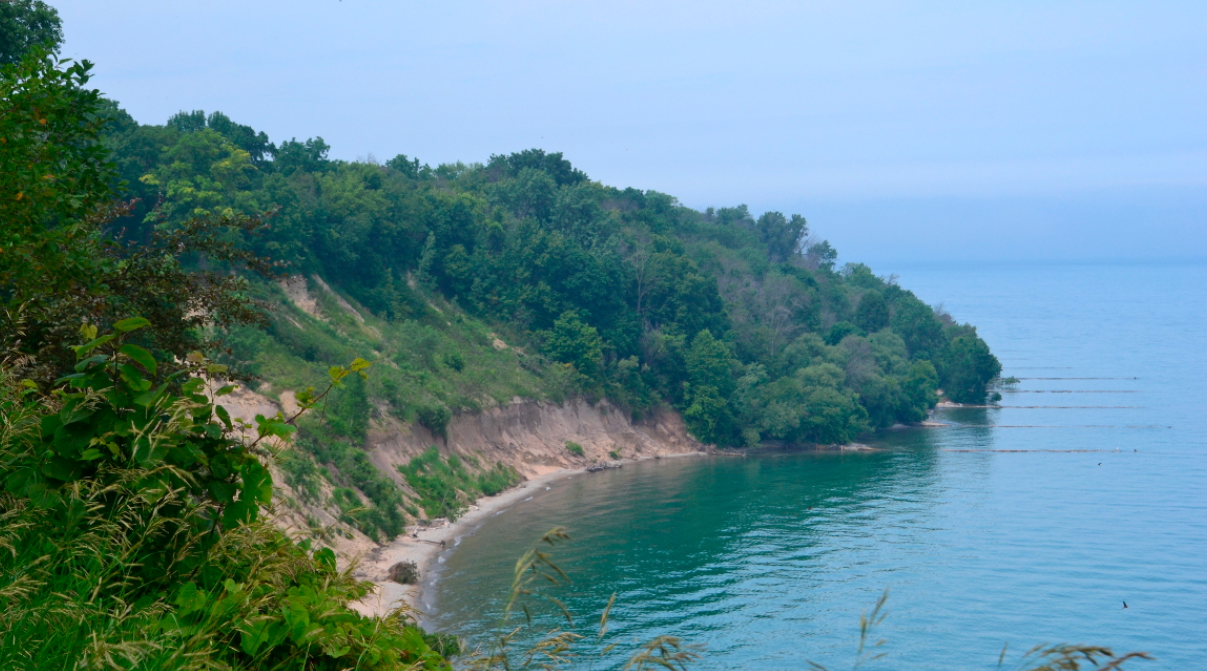
The erosion process is caused by various factors such as waves hitting the shore, runoff water from heavy rains, water moving through soil, freezing and thaw cycles, as well as strong winds. Bluffs have a crest at the top, and a toe at the bottom, often at the water’s edge. Impacts to the toe of the bluff can cause the whole bluff to slide and show impacts. Without a hardened toe and bluff stabilization, many of the coastline slopes in the Milwaukee region will erode until a stable bluff angle of around 22 degrees is reached.
Stronger storms and fluctuating lake levels are impacting this process, which Milwaukee County Parks has no control over. When lake levels are high, they can erode the toe and cause failures.
Groundwater seeps on the bluff face are also common causes of bluff failure.
The lakefront bluffs in Milwaukee County are considered coastal due to their soil type and risks, regardless of the fill that happened in front of them.
Bluff stability requires coastal engineering, which is extremely expensive due to complex access, wave dynamics, and regulations on the Great Lakes.
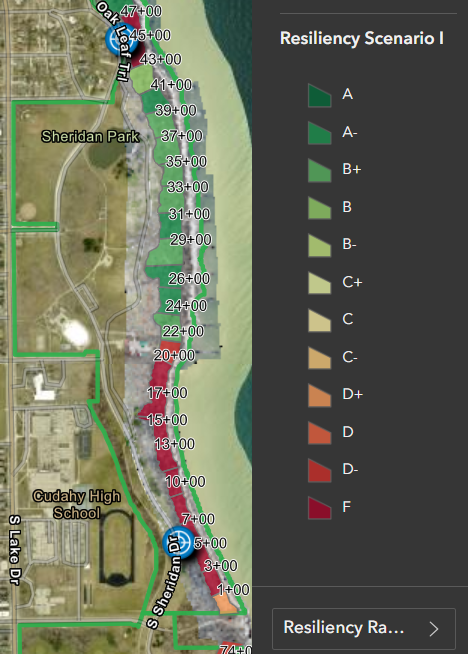
Parks has bluff erosion occurring in several locations across the park system. In addition to the trees and bluff impacts in the northern portion of Sheridan Park, significant bluff erosion is also taking place on the south end of Sheridan Park, near the Parks Service Yard. Bluff impacts have also caused trail closures and detours in Warnimont Park in the last month. Parks has also been working on a design solution to address the damaging impacts of bluff failure at Bay View Park. Evaluation of each bluff in Milwaukee County Parks can be viewed in the Bluff Assessment Study.
Sheridan Park Bluffs
In April of 2026, a unique storm event took place with significant damaging winds from the east. These gusts caused trees on the bluff crest to fall landward and lift the turf around them, resulting in soil from the top of the bluff falling down the slope. It is not believed that the April storms accelerated the movement of the toe of the bluff on the north end of Sheridan Park, though the slope angle may have changed.
In 2008, 2010, and 2020, the Federal Storm Disaster Declaration included records of bluff damage in Milwaukee County. Unfortunately, claims for bluff damage were denied FEMA funding.
In 2019 - 2021, the County worked with SEWRPC to create the WI Coastal Management grant- funded Coastline Management Guidelines. These guidelines provide best practices for limiting land-disturbing activities within the Lake Michigan Coastline Management Zone that extends from the toe of the slope to 100’ past an estimated stable slope distance.
Parks worked with regional partners in 2023 to apply for coastal management and habitat restoration funds via the NOAA Climate Resilience Grant. Unfortunately, these funds were not secured.
Milwaukee County used ARPA funding to complete a countywide Bluff Assessment Study in 2024.
In 2024, Wisconsin Sea Grant and the WI Coastal Management Program funded a study evaluating the efficacy of the groin field at Sheridan Park.
 Sheridan Park Bluff
2026 Current Project Status
Using priorities set in the 2024 Bluff Study, in 2025, Parks requested funding for a 2026 capital project to complete a coastal engineering design solution for Sheridan Park, but it was not included in the adopted budget.
Parks has resubmitted the Sheridan Park Bluff design project for consideration in the 2027 capital budget and remains hopeful it will receive support.
In the meantime, Parks has taken precautionary steps by fencing off areas along the bluff, as public safety is a priority, and we will continue to monitor conditions closely while pursuing funding and long-term resiliency solutions.
The current financial request is approximately $1 million for planning, design, and permitting, with full construction estimated to cost more than $18 million overall. This costly endeavor will require substantial support and funding to address.
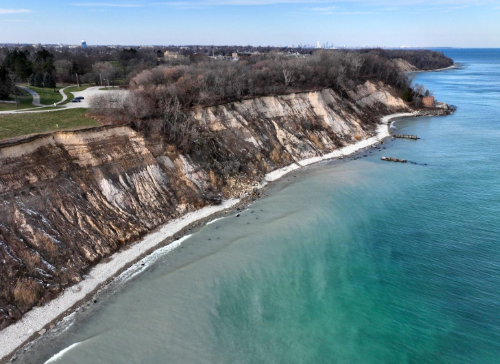 Warnimont Park Bluff
How can you help?
For now, we recommend that residents stay back from bluff edges, follow local rules, and continue to report erosion concerns.
Residents can still enjoy the Oak Leaf Trail parallel to the Sheridan Bluffs, as it is a much safer destination for recreational activities and viewing the lake.
